
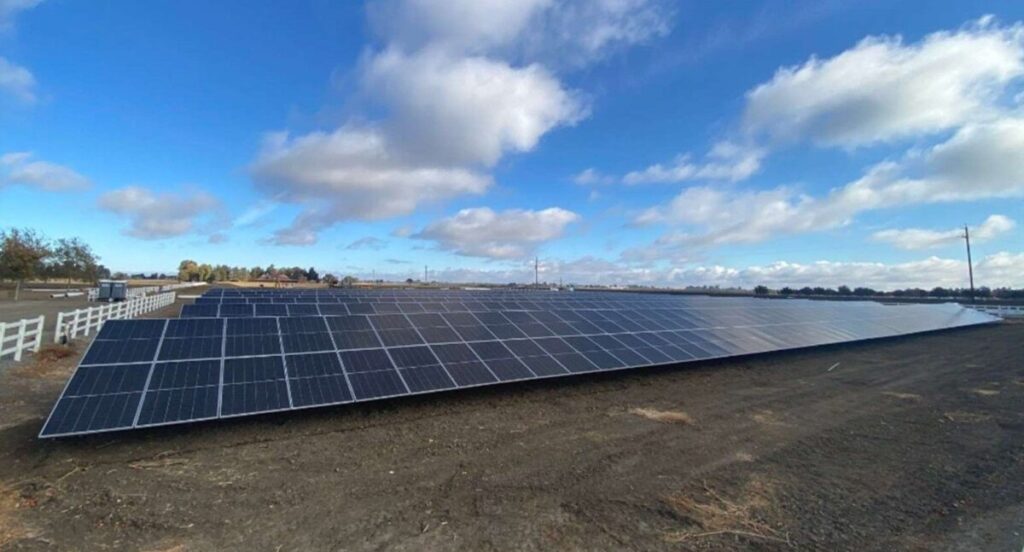
Two AgReserves operations in California – Deseret Farms of California (DFC) in Chico and South Valley Farms (SVF) in Wasco – are making a major shift to solar power. Once fully operational, new solar arrays will meet nearly 100% of their average electricity needs.
“This is more than a financial decision – it’s a strategic investment in the future of our tree nut operations in California,” said David Wright, Vice President of AgReserves’ Tree Crops Division. “Solar is a way we can care for the land, support our communities, and lead by example. It is a significant project for us, and we’ll see the benefits for decades to come.”
That vision aligns with broader company commitments to work sustainably and with operational excellence, said AgReserves Sustainability Sr. Manager Alyssa Sheehan. “By replacing traditional energy sources with renewables, the team has not only supported a reduction in carbon emissions but also paved the way for long-term energy resilience and cost savings.”
From Idea to Implementation
The idea took root in 2016 after a land purchase included existing solar infrastructure. Over time, the concept gained traction, and by 2023, the project was underway. In 2024, eight sites were completed, and another 24 are expected to be finished by the end of 2025. The remaining five are planned to be completed by April 2026.
DFC General Manager James Strong and Tree Crops Director of Finance Darryl Melanchuk were key drivers of the initiative. “The financial need for solar is due to skyrocketing utility rates in California and the high proportion of our cost structure sitting in electricity,” Darryl said. “Between irrigation and processing, our operations rely heavily on power. Solar helps us manage those costs more effectively.”
Recent changes to state energy regulations also accelerated the decision. Incentives for solar producers have shifted, making it more advantageous to generate and consume power on-site rather than rely on utility credits.
Why Rates Are Rising
California’s electricity rates – second highest in the nation as of mid-2025 – have climbed sharply in recent years. Pacific Gas & Electric Company (PG&E), which services both operations, raised rates 118% from 2014 to 2024, according to the Santa Cruz Sentinel. A major factor is wildfire mitigation. Utilities have invested billions to improve safety and reliability after equipment-related fires, and those costs are being passed on to ratepayers.
A 2024 state report noted that California’s three largest utilities were authorized to collect $27 billion in wildfire-related costs from customers between 2019 and 2023. With additional pressures such as data center growth, extreme weather, and evolving environmental policies, future rate increases seem inevitable.
“These projects are going to have a really good return, better than what we projected as PG&E’s rates continue to go up,” James said.
Smart Scale, Smart Savings
Rather than large utility-scale installations, the team opted for smaller arrays – each spanning three to five acres – strategically placed across the orchards. The end result will be 37 separate arrays producing more than 30 megawatts of clean energy, enough to power thousands of homes.
The financial impact is significant. Combined, DFC and SVF expect to save several million dollars in the first year and recoup their investment in about seven years.
Working Sustainably
Working sustainably means creating long-term value by considering the full spectrum of stakeholders – financial, environmental, and beyond.
“It’s not just about short-term gains, but about building systems that endure,” Alyssa said. “The most effective sustainability strategies are those that align environmental benefit with operational efficiency, and working sustainably becomes not just a responsibility, but a smart investment.”
Andrew Downie, Director of Sales and Marketing for Tree Crops, sees solar as a key part of the division’s value proposition. “Customers increasingly ask about sustainability. Now we can say we’re powered by nearly 100% solar, and that resonates.”
Beyond business, the impact is personal. Andrew said he likes knowing the company is doing something to help the planet: “The local population here, they’ll be driving around, they’ll see that we have this, and in their minds they’ll think, ‘OK, they’re doing the right thing. They’re trying to take care of the planet and all of us residents in the area.’ So, I think that’s good.”
James agreed, saying “I feel like we’re doing the right thing. We’re trying to improve the bigger picture for everyone.”